
CEO Column

- CEO Column
- Japan’s soccer gets stronger, Japan’s economy grows weaker
Japan’s soccer gets stronger, Japan’s economy grows weaker
2026/08/01
values

Once again, Japan’s run at the FIFA World Cup in North America ended in disappointment. I’m not usually much of a soccer fan, but this time even I set my alarm in the middle of the night to watch Japan take on Brazil. There was a feeling that, if the team could somehow pull off an upset, the momentum might carry them all the way to the final—who knows, maybe even to the championship. People were saying that this year’s squad had both the individual talent and the team cohesion to compete at a high level. But once the excitement had worn off and I took a step back, it occurred to me that there were probably many other national teams at about the same level. Perhaps I had simply been a little too optimistic in my assessment. Viewed objectively, Japan is probably a team whose place is around the last 32 in the world—with a favorable draw, perhaps capable of reaching the round of 16. In the context of world soccer, Japan is, perhaps, a fairly capable team that can beat one of the stronger nations from time to time.
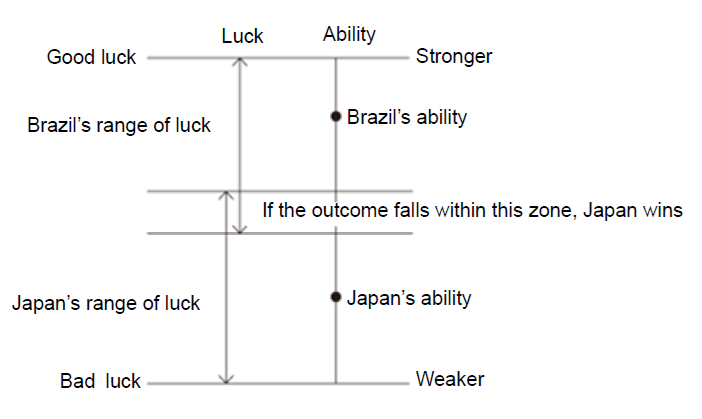
I say “from time to time” because results are never determined by ability alone. In sport, the outcome depends not only on ability but also on luck. The figure below illustrates how I think about the outcome of a match between Japan and Brazil. As the figure suggests, if Brazil’s shots were to strike the post instead of going in while Japan enjoyed the opposite fortune, the outcome would fall into the range where Japan could emerge victorious. The figure depicts the relationship between ability and luck. As for the role of luck, I discussed it in greater detail in my January 2023 column, written during the World Cup in Qatar four years ago, so I will refer interested readers to that essay.
This time, however, I would like to focus on a World Cup observation that has nothing to do with luck. What caught my attention was realizing, when I switched on the television to watch the Japan–Brazil match, that NHK was broadcasting the game at the same time as a commercial television network. My first reaction was, “Broadcasting rights can’t be cheap, so why would two channels split the audience by airing the same match?” It also made me wonder, “If the game is already available on commercial television, is it really necessary for NHK, Japan’s public broadcaster, to air it as well?” Soccer is, of course, a popular and familiar sport in Japan, and many people are interested in the national team’s matches. But it would be difficult to say that it is a matter of overwhelming public interest. It is, after all, one major entertainment program among many. Unlike news, disaster coverage, or parliamentary broadcasts, does NHK really need to broadcast World Cup soccer matches in the first place? That said, I thought such a decision might still be justifiable if the broadcasting rights were inexpensive, so I decided to look into how much they actually cost.
Of course, they aren’t cheap.
According to a Nikkei report, the domestic broadcasting rights for this World Cup are estimated to be worth around \35 billion in total, although the actual figure has not been disclosed due to contractual agreements. The rights are shared among DAZN, NHK, Nippon TV, and Fuji TV. The amount paid by NHK has not been made public. However, given that it is broadcasting every Japan match as well as many of the tournament’s major matches, I would estimate its share is no less than \10 billion.
Against this backdrop, NHK released its financial results for fiscal 2025. According to the report, NHK generated \613.0 billion in operating revenue but posted an operating deficit—the equivalent of a corporate net loss—of \31.8 billion. The first point I would like to make is this: is it appropriate for an organization running a deficit to spend such an enormous sum on something that does not necessarily serve the interests of the overwhelming majority of the public? The second point is that, despite the size of the expenditure relative to NHK’s annual operating budget, the actual amount paid has not been disclosed because of contractual obligations. Is it appropriate to commit such a large amount of money—funds collected from the public in a manner akin to a tax—to a contract whose financial terms cannot be disclosed? If NHK believes it has an obligation to be transparent with the public, should it not instead have made the decision, “if we cannot disclose the terms of the contract, then we should forgo purchasing the broadcasting rights”?
Having said all that, I do not intend to argue that NHK was wrong to acquire the World Cup broadcasting rights. Personally, I believe that, as Japan’s public broadcaster, NHK should devote its resources to issues that are more closely tied to people’s lives—such as politics, the economy, national security, disaster preparedness, and other important social challenges. At the same time, I recognize that people hold different views. If the issue is openly debated and a decision is ultimately reached through that process, I have no objection. What I do want to argue is this: Is it really acceptable for issues that are likely to generate differing opinions to be dealt with quietly, without ever being brought into the open for public discussion?
In short, the central theme of this column is to raise awareness of two issues: a public that lacks a sense of what problems ought to be questioned, and a society that keeps potentially controversial issues out of the public eye, with the result that they are never openly debated. These are deeply rooted challenges. Moreover, because they ultimately come down to the issue of education, they require a very long-term perspective. When will the day come when people and organizations with real influence in society bring these issues onto the public agenda?
Having written all this, I later came to a new realization about why things turned out this way. Put simply, the broadcasting rights for the World Cup have become so expensive that commercial broadcasters, which rely on advertising revenue, simply cannot afford them. As the value of the broadcasting rights has continued to rise and the yen has weakened, it has become impossible for commercial broadcasters to make the World Cup financially viable. As a result, NHK was called upon to step in and, by using funds that are collected in a manner akin to a tax (and are therefore not subject to the same commercial profitability constraints), ensure that the public would not be left with a situation in which the World Cup could only be watched on paid television. That, I suspect, is the reality of the situation.
In contrast to Japanese soccer, which is steadily closing the gap with the world’s top teams, watching this World Cup made me keenly aware of the hardship brought on by the weak yen and Japan’s decline from the ranks of the world’s leading economies.
Hirotaka Shimizu
Chairman and CEO
Kamakura Shinsho, Ltd.
Image material:PIXTA